
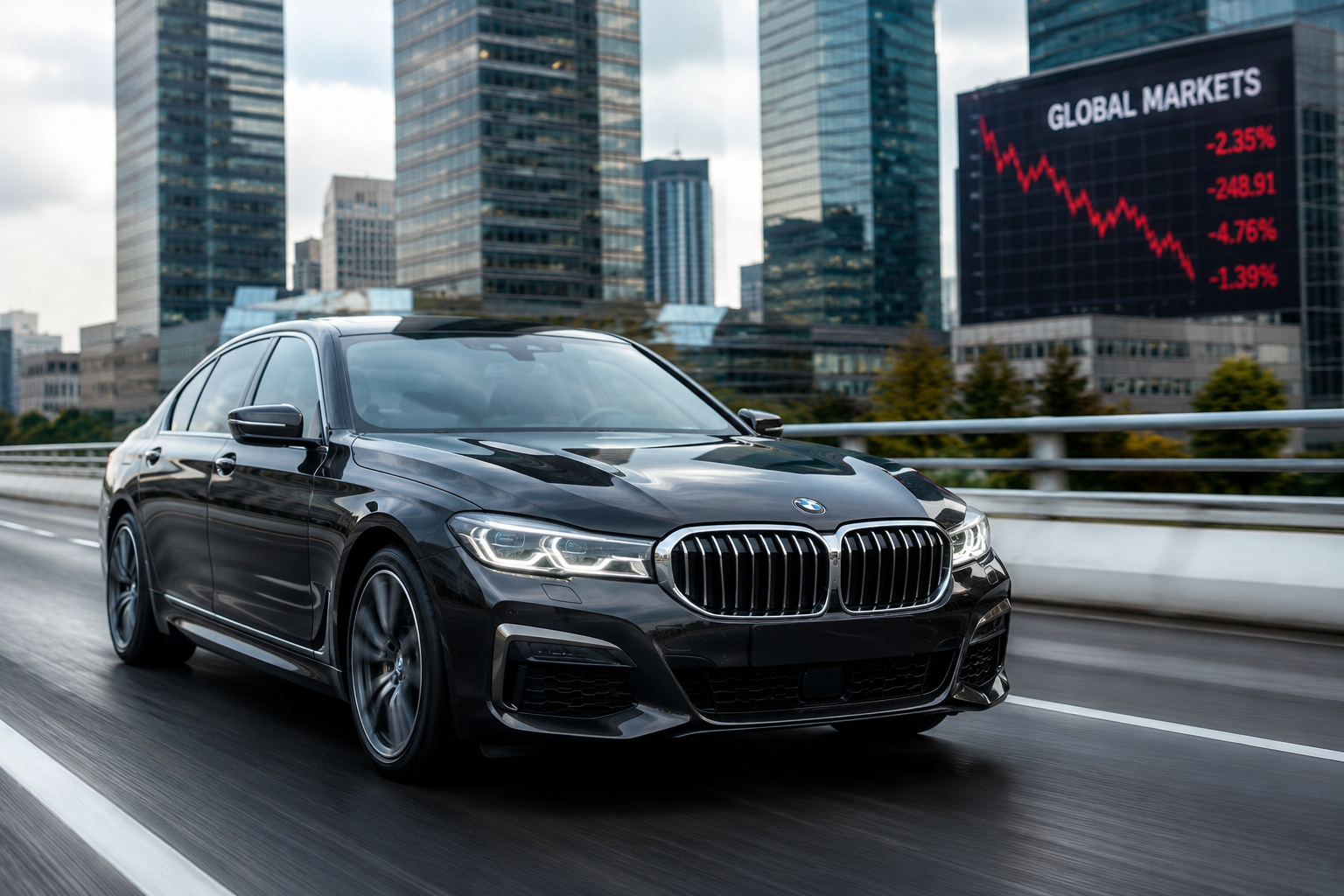
BMW stock remained in focus on Wednesday as investors positioned for first-quarter results that delivered a meaningful beat on earnings estimates, even as pre-tax profit plunged by a quarter and revenue fell sharply.
The result confirmed that Europe’s premium car industry is absorbing the twin drag of US and EU tariffs and continued weakness in China, but doing so with greater resilience than the market had feared.
That’s a combination that has kept BMW’s stock above its mid-year lows even as the broader macro backdrop remains challenging.
BMW Q1 earnings: Numbers at a glance
BMW said on Wednesday that pre-tax earnings came in at 2.3 billion euros — equivalent to approximately 2.7 billion dollars — in the first quarter of 2026, compared with the analyst consensus of 2.2 billion euros compiled by the company.
The result nonetheless marks a steep 25% decline from the same period a year earlier, reflecting the combined impact of lower volumes, tighter pricing in China, and the direct cost of tariffs on vehicles and components flowing between the US, Europe and Asia.
Group revenue fell 8.1% to 31.0 billion euros, while the EBIT margin in the core automotive business stood at 5.0% — above analysts’ forecast of 4.7% and comfortably within BMW’s full-year target corridor of 4% to 6%.
The margin outperformance is significant given that BMW had flagged tariffs alone would carve 1.25 percentage points from its automotive EBIT margin in 2026.
Stock and shareholder returns
BMW ordinary shares closed at 77.185 euros on 5 May, up from a previous close of 76.020 euros and within a day range of 75.670 euros to 77.270 euros.
The stock’s 52-week range spans 70.94 euros to 97.92 euros, leaving it well below its peak even after recent gains.
At current levels, the shares trade on a price-to-earnings multiple of approximately 6.4 times trailing earnings.
The historically low valuation reflects the market’s caution about the trajectory of the automotive cycle rather than any structural deterioration in BMW’s business model.
The stock will trade ex-dividend on 14 May, with a payout of 4.40 euros per share expected — implying a dividend yield of approximately 5.7% at current prices.
BMW’s ongoing 2025–2027 share buyback programme, under which it repurchased 54,000 shares in late April, provides an additional layer of capital return for shareholders navigating a period of compressed earnings.
Tariffs and China weigh on performance
The headwinds confronting BMW are structural rather than transitory.
US import tariffs — set at 25% on European cars and trucks since President Trump’s escalation earlier this year — and EU anti-subsidy charges on battery electric vehicles manufactured in China are together eroding profitability across the group’s product lines.
BMW’s Spartanburg plant in South Carolina, its largest in the world, has provided some natural hedge against US import tariffs, but the group’s Chinese-made Mini models remain exposed to EU levies, adding costs in the low hundreds of millions of euros.
Global vehicle deliveries fell 3.5% in the first quarter to 565,748 units, with BMW brand sales down 4.6% to 496,050 vehicles.
US demand for BMW and MINI fell 4.3% to 90,492 vehicles, while deliveries across Asia-Pacific, Eastern Europe, the Middle East and Africa slipped 8.3%.
China, which accounts for a quarter of BMW’s global volume, remains the most acutely challenged market.
Sales in China fell 12.5% in 2025, and BMW has guided for deliveries to remain broadly flat in 2026.
Full-year guidance and the road ahead
BMW expects group pre-tax earnings to decline a further 5% to 9.9% in 2026, from the 10.2 billion euros recorded in 2025, with the automotive EBIT margin forecast to land in a 4% to 6% range — down from 5.3% in 2025 and 6.3% in 2024.
That guidance was set before the full impact of the US-Iran war on energy prices and supply chains was known, and analysts have since flagged additional downside risks stemming from higher fuel costs and weaker consumer confidence in key markets.
Chief executive Oliver Zipse has argued that BMW’s technology-open strategy — offering vehicles with combustion engines, plug-in hybrids and battery-electric powertrains — positions the group better than rivals who have committed more heavily to pure-electric models in a market where EV adoption has proved uneven.
“We have set the right course in recent years and do not need to change our strategic direction,” Zipse said.
“In this way, we can keep the company on track for long-term success.”
BMW stock: Should you buy?
The consensus analyst price target for BMW stands at 91.59 euros, with a high estimate of 108 euros and a low of 69 euros.
Of analysts covering the stock, 10 recommend buying while four suggest selling.
Bernstein maintained a buy rating on 4 May, while RBC Capital Markets has a hold rating with a price target of 84 euros, citing raw material cost pressure and adverse currency effects as key risks to margin guidance.
JP Morgan retains an overweight rating with a price objective of 100 euros.
Mercedes-Benz is due to report its own first-quarter 2026 results in the coming days, and its figures will provide a direct read across on how German premium manufacturers are managing the same combination of tariff costs and uneven China demand.
The comparison will be closely watched — Mercedes posted a 43% drop in first-quarter net profit to 1.7 billion euros in Q1 2025, a markedly steeper decline than BMW’s, and investors will be alert to any change in that relative positioning.
The post BMW beats estimates despite profit slump: is the stock a buy now? appeared first on Invezz
