
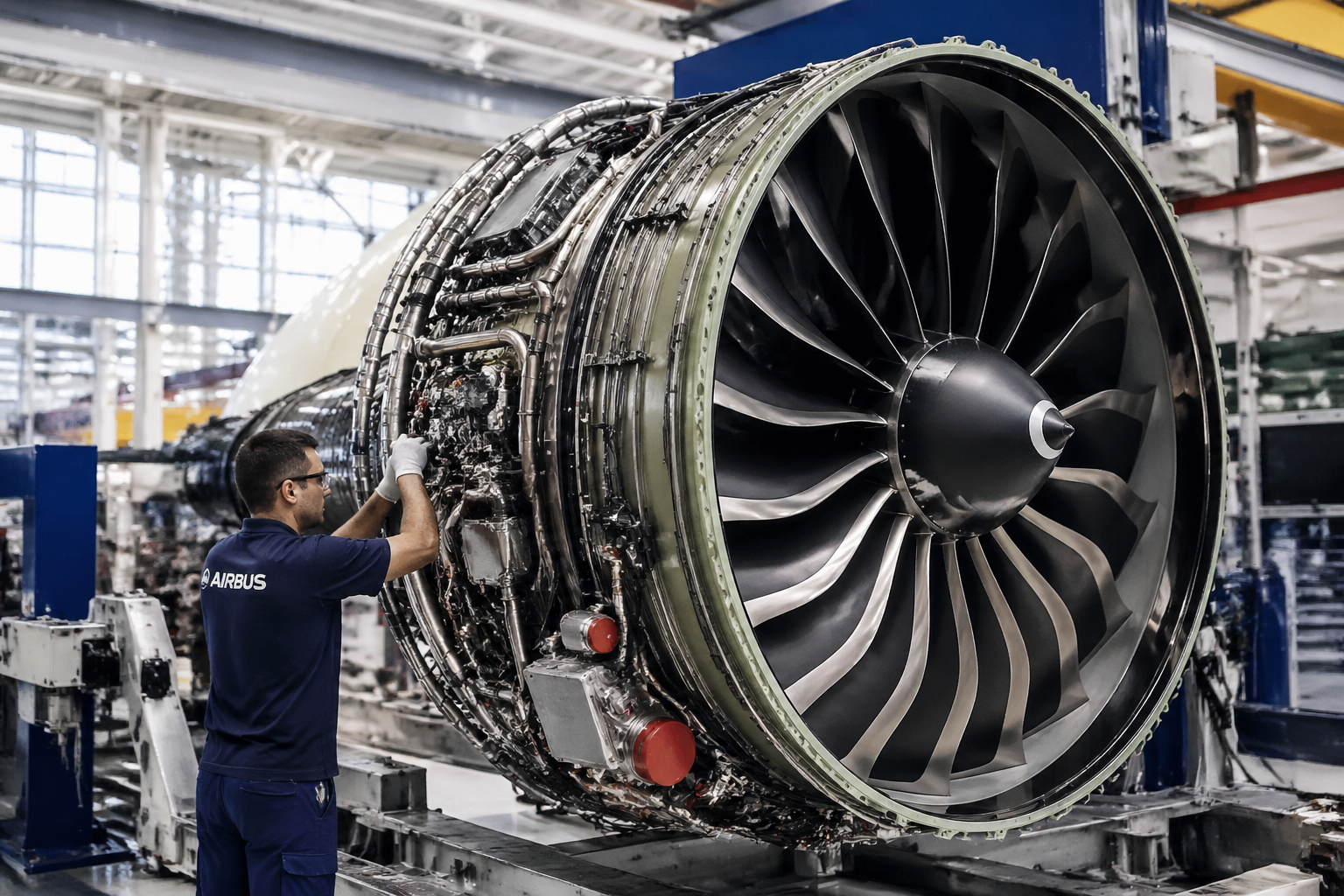
Airbus reported a sharp decline in first-quarter earnings on Tuesday, as supply chain disruptions—particularly engine shortages—curbed aircraft deliveries and weighed on profitability.
Adjusted operating profit fell 52% year-on-year to 300 million euros, well below analyst expectations of 348 million euros.
Revenue declined 7% to 12.65 billion euros in the three months to March 31, though slightly above consensus estimates of 12.39 billion euros.
Net profit also dropped 26% to 586 million euros.
The world’s largest planemaker delivered 114 commercial aircraft during the quarter, down 16% from 136 a year earlier and trailing Boeing, which delivered 143 aircraft over the same period.
Despite the weaker performance, Airbus maintained its full-year delivery target of around 870 aircraft for 2026, compared with 793 deliveries in 2025.
Engine shortages and supply issues persist
A key factor behind the slowdown has been ongoing delays in engine deliveries from Pratt & Whitney, a subsidiary of RTX Corporation.
Airbus said the shortage has forced it to slow production of its best-selling A320 jets, even as demand remains strong.
Chief Executive Guillaume Faury acknowledged the ongoing dispute with the supplier, stating:
“We’ve not come to the point where we have an agreement,” Faury said, “but we continue to work both ways — the dispute on the one hand and a negotiation on the other hand to constructively resolve the disagreement we have.”
The company had already initiated steps earlier this year to enforce its contractual rights against the engine maker due to supply shortfalls.
Additional supply chain challenges, including delays in sourcing components such as seats and toilets, have further complicated production timelines.
Airbus has previously trimmed delivery targets in multiple years due to these persistent bottlenecks.
An administrative delay affecting nearly 20 aircraft destined for Chinese customers also contributed to the first-quarter delivery shortfall, though the issue has since been resolved.
Outlook steady despite challenges
Despite near-term headwinds, Airbus reiterated its production and financial targets, signaling confidence in its ability to navigate supply constraints.
The company continues to aim to produce between 70 and 75 A320-family aircraft per month by the end of 2027.
It also reaffirmed plans to ramp up production across other models, including the A220, A330, and A350 in the coming years.
For 2026, Airbus expects adjusted EBIT of around 7.5 billion euros and free cash flow before customer financing of approximately 4.5 billion euros.
Faury noted that geopolitical risks remain a factor, particularly in the Middle East, but emphasized that demand has held up.
“The operating environment remains dynamic and complex. We are closely monitoring the potential impact from the fast-changing situation in the Middle East,” Faury said. “In commercial aircraft, we continue to ramp up and produce as per our plan while navigating the shortage of Pratt & Whitney engines.”
High jet fuel prices are also supporting demand for fuel-efficient aircraft, even as some airlines adjust flight frequencies.
However, persistent supply-chain disruptions have weighed on investor sentiment, with Airbus shares down more than 16% since the start of the year.
Meanwhile, Boeing has regained momentum, supported by improving operations and stronger delivery performance.
Airbus now faces the challenge of accelerating production in the remaining quarters of the year to meet its delivery targets while resolving ongoing supply constraints.
The post Airbus profit halves as engine delays curb deliveries appeared first on Invezz
