
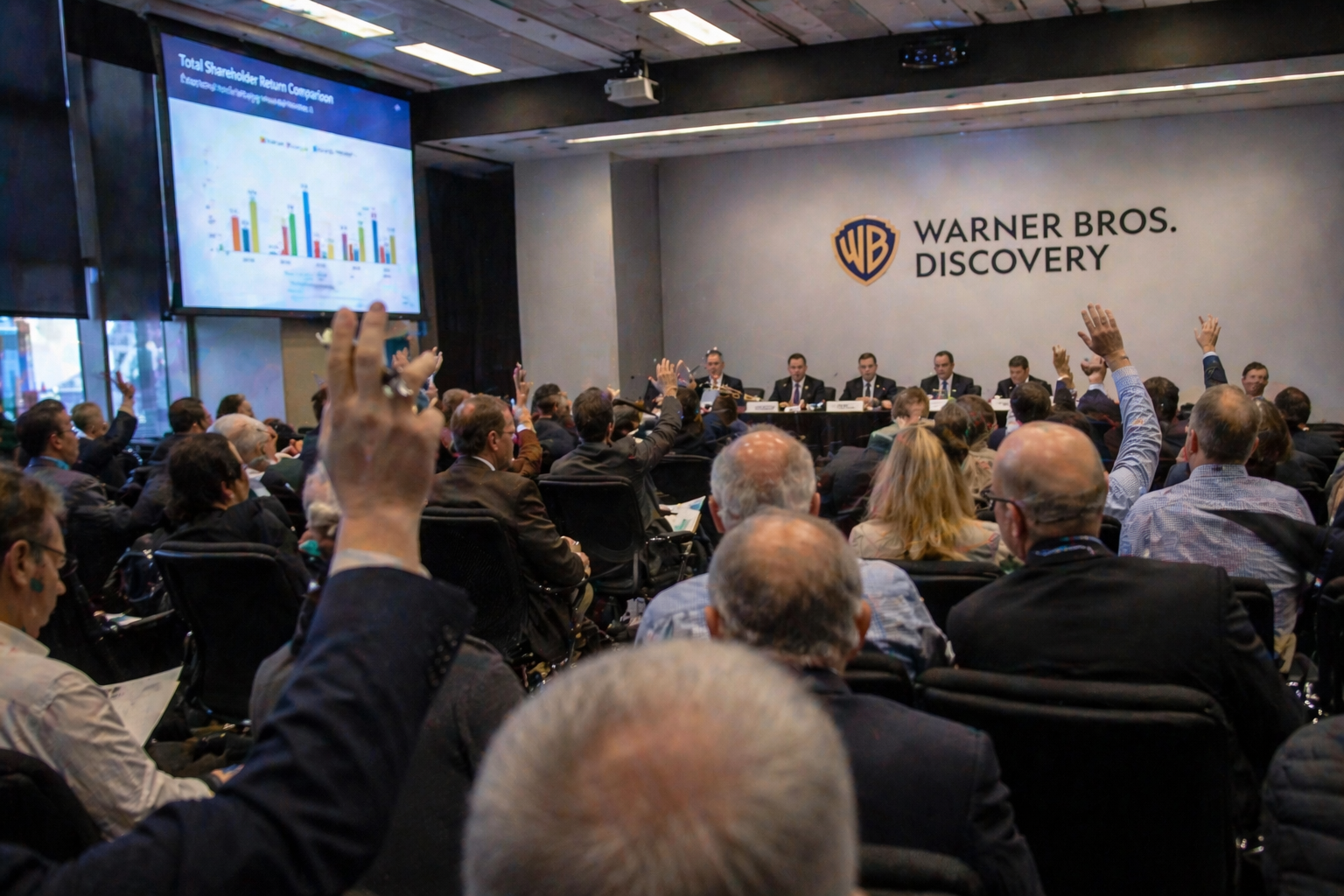
Paramount’s ambitious $110 billion bid to acquire Warner Bros. Discovery is approaching a decisive moment, as shareholders prepare to vote on the deal on Thursday, bringing the media industry closer to one of its largest consolidations in recent years.
The proposed transaction, which has already secured unanimous backing from the boards of both companies, is widely expected to win shareholder approval at the special meeting scheduled for tomorrow.
If approved, the deal would mark a significant step toward creating a media powerhouse with an expansive portfolio spanning film, television, and streaming.
Shareholder vote seen as key but not final step
Investor sentiment appears tilted in favour of the acquisition, driven in part by the premium offered.
Shares of Warner Bros. Discovery had traded at significantly lower levels over the past year, making the $31-per-share offer from Paramount Global attractive to many investors seeking certainty.
The companies have indicated that the transaction is expected to close in the third quarter of 2026, subject to shareholder approval and regulatory clearances.
A “ticking fee” clause will compensate shareholders of $0.25 per share if the process extends beyond September 2026.
However, analysts caution that the shareholder vote is only one milestone in a lengthy process.
Anders Bylund, contributing media and technology analyst at The Motley Fool, noted: “But that’s not the whole story. Roughly speaking, that’s step nine of approximately 47,” highlighting the complexity of bringing such a large transaction to completion.
Regulatory outlook appears largely favourable in the US
In the United States, the regulatory outlook appears relatively favourable, at least initially.
Brendan Carr, chair of the Federal Communications Commission, has publicly expressed support for the deal, stating last month, “I think this is a good deal, and I think it should get through pretty quickly.”
That view reflects a broader perception that the current administration may be less inclined to block large-scale media mergers.
At the same time, political dynamics continue to shape the narrative around the deal.
Following the Warner Bros. Discovery shareholder vote on Thursday, Ellison is expected to attend a Washington dinner “honoring the Trump White House and CBS White House correspondents.”
The gathering aligns with the White House Correspondents’ Association’s annual dinner on Saturday, which Donald Trump is set to attend for the first time as president.
The Paramount-hosted event, first reported by Lachlan Cartwright’s Breaker newsletter, has attracted sharp criticism, with some opponents of the merger planning protests outside the venue on Thursday evening.
The company has declined to comment on the event, though the timing has drawn attention, given the ongoing regulatory scrutiny of the Warner Bros. Discovery transaction.
According to reporting by CNN, a person close to the transaction said, “We have been talking with regulators for months and months already,” suggesting that discussions with authorities are well underway.
Yet opposition remains.
Democratic state attorneys general are exploring potential antitrust challenges, raising concerns about market concentration.
Their recent success in halting a separate broadcast acquisition has reinforced the possibility of legal hurdles emerging at the state level.
Questions have also been raised about the financing of the deal, which includes investments from sovereign wealth funds in the Middle East.
While Paramount Global has indicated these investors will not hold governance rights, the involvement of foreign capital could still attract scrutiny.
European regulators could emerge as decisive gatekeepers
While US approval may prove manageable, analysts say the more formidable challenge lies overseas.
Regulators in both the United Kingdom and the European Union are expected to closely examine the implications of combining two major media players.
The UK’s Competition and Markets Authority has already initiated consultations, signalling heightened interest in the deal’s potential impact on competition.
Their concerns are not unfounded.
A merged Paramount–Warner entity would control a vast portfolio, including HBO, Paramount+, Channel 5, Eurosport, MTV, and Nickelodeon, along with the theatrical distribution networks of both studios—concentrating a significant share of the media landscape under one umbrella.
Parallel scrutiny from the European Commission is also anticipated, with a focus on streaming dominance, content distribution, and consumer choice across the bloc.
Analysts at Wall Street research firm MoffettNathanson, as cited in industry coverage, suggested regulators could push for concessions such as divestitures of regional channels or smaller cable networks in Europe to secure approval.
Competitive landscape and industry implications
Supporters of the deal argue that consolidation is necessary to compete with larger, well-funded rivals.
The combined company would still face stiff competition from streaming giants such as Netflix, as well as technology firms like Amazon, Apple, and Google, all of which have expanded aggressively into content and distribution.
Alden Abbott, former chief legal officer at the Federal Trade Commission during Donald Trump’s first term, downplayed antitrust risks in a blog post, describing concerns as “much ado about not much.”
He wrote that the deal “does not present a clear mechanism for anticompetitive harm, nor does it appear likely to enable the exercise of market power,” while also pointing to potential efficiencies that could strengthen competition.
The post Warner Bros. Discovery’s shareholders to vote on Paramount’s offer tomorrow appeared first on Invezz
