
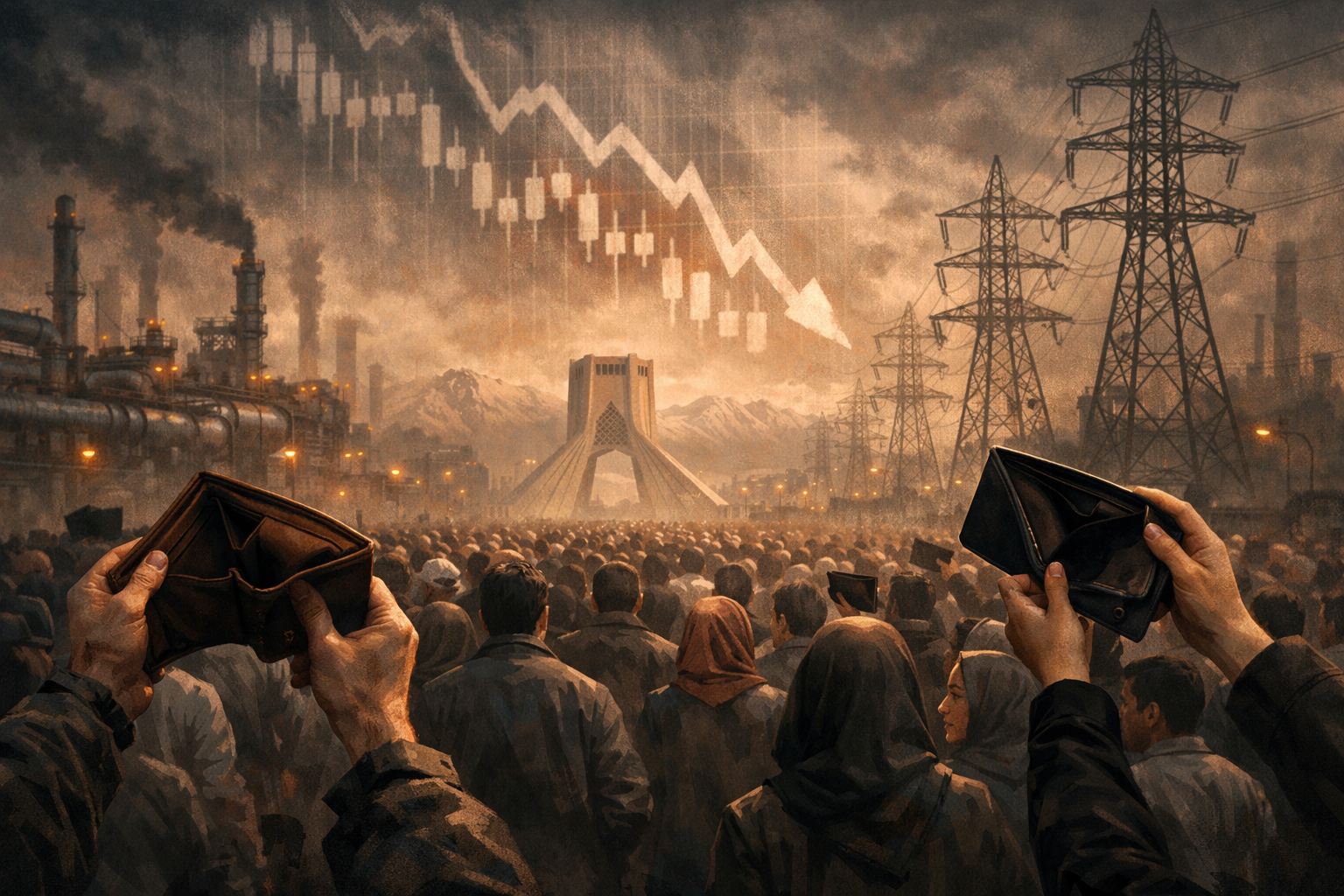
The current protests burning through the streets of Tehran are the final, desperate symptom of the collapse of Iran’s economy.
The Iranian state has traded its people’s prosperity for regional influence, betting that the population would stay quiet as long as the regime stayed strong.
And this has been going on for decades now. Until the people decided they’ve had enough.
The reality on the ground is that the social contract has been shredded by a combination of hyperinflation and the physical destruction of the nation’s energy heart.
Experts and citizens alike now see a country where the math of daily life simply does not add up anymore.
How the rial became a ghost currency
On December 28, 2025, the Iranian rial stopped functioning as a tool for trade and became a symbol of national decline. It reached a record low of 1.47 million to the US dollar, which effectively erased the life savings of the middle class in a single afternoon.
Merchants in the Grand Bazaar who have traditionally supported the state are now shuttering their shops because they cannot price their goods.
They feel a sense of shame when they have to tell a customer that a pair of shoes or a coat costs twice what it did yesterday.
The Iranian currency has lost about 20,000% of its value since the 1979 revolution, but the recent drop is different because it has no bottom.
People are trading their furniture and jewelry for gold or dollars just to keep their heads above water.
Source: Bloomberg
Although the government replaced the central bank governor in a panic, the move did nothing to stop the bleeding.
The rial is now a ghost currency that most businesses try to avoid using entirely.
General inflation in Iran now sits at 52.6% while food inflation has climbed past 70%, making the simple act of eating a source of constant anxiety for millions of households.
The high cost of a shadow war
The economic misery is not just a result of bad banking policies because the physical infrastructure of the country is also failing.
During the 12-day war in June 2025, Israeli and American strikes hit several nuclear sites and energy facilities.
These attacks did more than just set back the nuclear program, as they also crippled the power grid and gas pipelines.
This has led to constant electricity blackouts and gas shortages during the coldest months of the year.
To make matters worse, the shadow fleet of 560 tankers that Iran uses to sell oil is losing its effectiveness.
The capture of the Venezuelan president in early January 2026 by the United States has sent a shockwave through the network of sanctioned nations.
Iran now has to sell its oil to small refineries in China at a discount of nearly 50% below the global market price.
While the country is still pumping 3.2 million barrels a day, the actual revenue that makes it back to the treasury is a fraction of what is needed to run a nation of 92 million people.
Most of this oil flows through the Malacca Strait via ship-to-ship transfers with transponders turned off, yet the costs of this secrecy consume the very profits intended to save the state.
A budget for the elite and a coupon for the poor
The 2026 budget recently proposed by the administration shows exactly where the priorities of the state remain.
It includes a massive increase in funding for the security forces and the Revolutionary Guard, which now receives nearly four times the allocation it had two years ago.
This decision was made even as the government raised the value-added tax to 12% to cover a gaping deficit of 950 trillion Toman.
To prevent a total uprising, the president announced a plan to give every citizen a monthly coupon worth about $7.
For a family in a city like Shiraz or Mashhad, this amount is barely enough to buy a few kilograms of meat or a small supply of medicine.
Many Iranians have discovered that their pension funds are largely insolvent, leaving an entire generation of retirees with nothing but worthless paper.
The gap between the wealthy elite who have access to hard currency and the working class has never been wider.
While the children of officials are seen on social media living in luxury in Western cities, the average citizen is being told to tighten their belt for the sake of an ideology that no longer provides for them.
Why the security forces are starting to hesitate
The protests have now spread to all 31 provinces, reaching far beyond the student activists in the capital.
Even the poor and conservative towns that were once the backbone of the regime are now joining the unrest.
In the western province of Ilam, the situation turned particularly violent when security forces stormed a hospital to arrest wounded protesters.
This act of desperation backfired because it outraged the local population and led to even larger crowds in the streets who refused to be intimidated.
Source: CNN
There are reports that some rank-and-file officers are beginning to show signs of exhaustion and hesitation.
These soldiers are facing the same 70% food inflation as the people they are supposed to suppress.
They are being paid in the same worthless rial, and many of them are questioning why they should protect a system that cannot even feed their own families.
Although the government has increased the use of the death penalty to silence dissent, the fear seems to be vanishing as the economic stakes become absolute.
Underemployment among university graduates has reached 25%, creating a massive class of educated people with no path to a stable life.
The search for a normal life
Iranian protesters are not looking for a complex political ideology; they are simply looking for what they call a normal life.
They want to be able to plan for next month without worrying that their money will be worth half its value by Friday.
The regime has spent decades trying to convince the population that they are part of a grand historical struggle against the West; however, that narrative is failing because it does not put food on the table.
The country is experiencing a massive brain drain as doctors, engineers, and scientists leave for any country that will take them.
The state is left with a population that is both angry and has nothing left to lose.
Protesters in the city of Yasuj recently shouted that while the children of the elite are in Canada, their own children are in prison.
This sentiment has replaced the old slogans of the revolution. The struggle in Iran today is about the right to exist without the constant weight of a failing state.
They are finding out that you can rule by force for a long time, but you cannot rule on an empty stomach forever.
This is the moment where the desire for a predictable and dignified life has finally outweighed the fear of the secret police.
The post How rising costs and a currency collapse have led to Iran protests appeared first on Invezz
